

Building the Future: How Forward-Thinking, Ecologically Responsible Construction Empowers
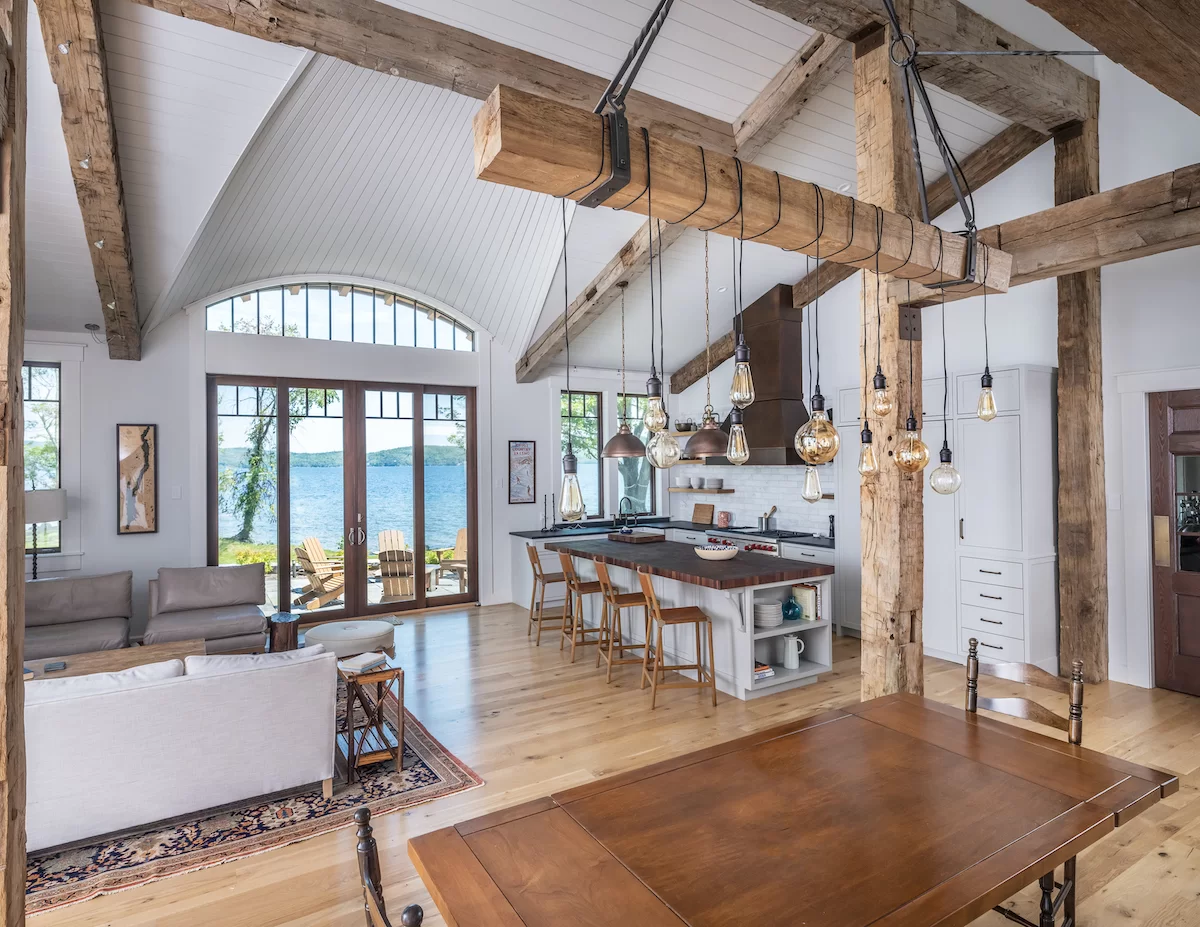
Sustainable design doesn’t have to scream, I’m GREEN!
It can be accomplished with expert knowledge, clever choices, and a holistic approach. As Phinney Design Group has proven repeatedly in the past 20 years – good design never goes out of style.
Riding the Environmentally-Aware Roller Coaster
Growing up in Lake George, Michael Phinney loved the outdoors. His grandfather was the Mayor of Essex County, his dad ran a marina, and he became the fifth generation of his family to enjoy hiking, camping, boating, and fishing there. In the 1990’s however, as a student at Rensselaer Polytechnic Institute (RPI) in Troy, he felt like an outsider.
“I had this desire to explore how architecture could coexist with, and make, the environment better.”
Michael’s thesis project at Rensselaer Polytechnic Institute (RPI) was on ‘Environmental Awareness in Architecture.’ As the Principal Architect at Phinney Design Group, founded in 2003, he has ridden the sustainable design roller coaster. Its popularity ebbs and flows, but its pinnacle was reached in 2001when then-Governor George Pataki issued Executive Order 111 instructing the state to adhere to energy efficiency goals. Michael worked on both the state’s first LEED-certified building, The Department of Environmental Conservation (DEC) located at 625 Broadway in Albany, NY, as well as the first LEED-certified building in the Adirondack Park.
Why Going Overtly “Green” Isn’t Your Only Choice
The Phinney Design Group is headquartered in the same sustainable building as The Local Pub and Teahouse, at the corner of Beekman St. and Grand Ave. in Saratoga Springs.
With a second office in Troy, the firm has amassed an accomplished portfolio spanning residential projects; popular restaurants including PJ’s Bar-B-QSA, The Local Pub and Teahouse, 550 Waterfront, Walt & Whitman Brewing, and the Common Roots Brewery and Tap Room; public spaces such as The Wild Center’s educational bio-building; as well as the historic preservation of behemoths including The Gideon Putnam, The Sagamore, Mohonk Mountain House, The Queensbury Hotel, and the Saratoga Race Course.
Although sustainable design is Phinney’s niche, their primary goal is to educate clients. Currently, eighty-percent of their clients select designs including what Michael calls “common-sense” solutions that cost the same or slightly more than traditional techniques while minimizing negative impacts on the environment.
Ten percent opt for a slightly larger investment in windows, insulation, heating and cooling systems, appliances, and lighting, that will pay themselves off in energy savings within one to seven years. The final ten percent may choose to invest in greater energy saving technologies and more careful sourcing of all materials to achieve a net-zero energy building and/or zero-carbon construction. These investments can require eight years or more for a return on investment, but make a great impact on the environmental health of our world long-term.
Poised for the Second Wave
As new sustainability measures are rolled out, Michael anticipates a second wave of increased demand for environmentally-responsible design.
Currently working on a net-zero mixed-use building in Troy, its three stories will showcase best-practices in an urban environment by reusing the existing structure, featuring state-of-the-art glass, and an all-electric commercial kitchen. Located along RPI’s pedestrian approach, the project is bringing Michael full-circle.
“It is interesting that here I am, 30 years later, building an example of something I dreamed about then. It’s very special.”
Rather than being the star player, today, Michael sees his role as more akin to that of a coach celebrating where the firm might go in the future, adding, “It’s not just me that makes the magic happen.”