

How Daigle Cleaning Systems Is Using Robotics to Redefine Commercial Cleaning
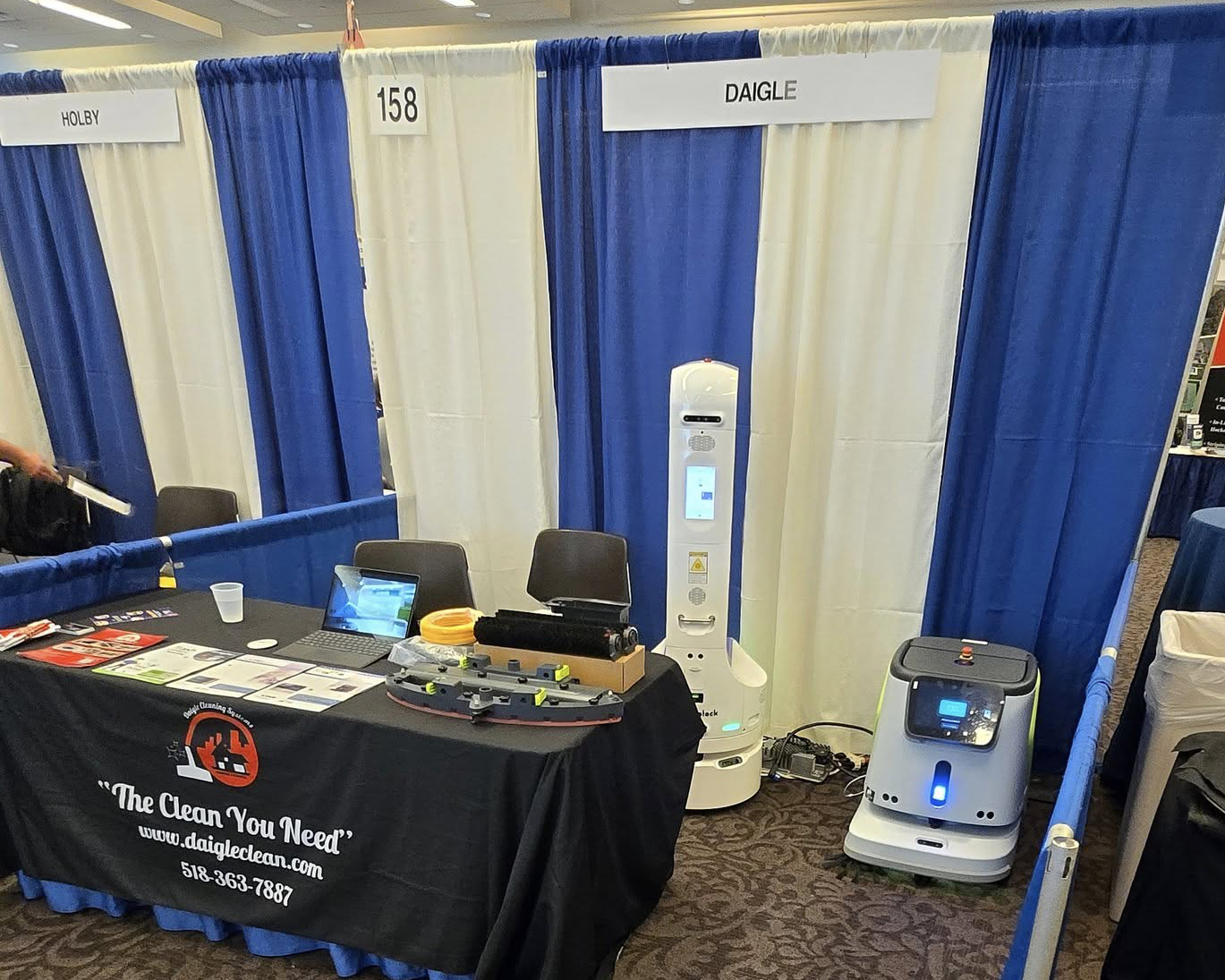
For decades, commercial cleaning has relied almost entirely on human labor. But as facilities grow larger, labor shortages increase, and expectations around cleanliness—especially in healthcare—continue to rise, that traditional model is being pushed to its limits. At Daigle Cleaning Systems, co-owner Derek Foster saw that pressure early and made a deliberate decision to integrate robotics into the company’s service offerings. Over the last couple of years, robotics have moved from experimentation to a core part of how Daigle delivers value to its clients.
Rather than replacing people, these robots are designed to automate repetitive, labor-intensive tasks, allowing human technicians to focus on detail work, safety-critical cleaning, and higher-value services.
What the Cleaning Robots Can Actually Do
Daigle Cleaning Systems deploys autonomous cleaning robots that are programmed for specific environments and tasks. These robots are not “plug and play.” Each one is mapped to a facility using onboard cameras, LIDAR technology, and a touchscreen interface. Once mapped, the robot follows exact instructions—no more and no less.
One of the primary machines Daigle uses is a four-in-one floor care robot often referred to internally as “Scrubby.” This robot can:
- Sweep hard floors
- Damp mop surfaces
- Auto-scrub tile and grout
- Vacuum carpeted areas
Because the robot stores facility maps in its internal memory and cloud systems, it can be scheduled to clean specific areas at specific times without constant supervision. The robot operates using Wi-Fi or a mobile hotspot and documents where it cleans, where it pauses, and where it must return later if an area is temporarily blocked.
The robots are equipped with 360-degree cameras and obstacle-detection sensors. When people or objects appear in their path, operators can choose whether the robot stops, reroutes around the obstacle, or pauses and returns later. In real-world environments—such as hospital waiting rooms—the robots safely navigate around patients and staff without collisions.
Daigle has also deployed ultraviolet disinfection robots designed for healthcare environments. These units use UVC light to disinfect surfaces and reduce the risk of hospital-associated infections. During demonstrations, multiple robots operated simultaneously in confined spaces without interfering with one another, highlighting how advanced the collision-avoidance and navigation systems have become .
Where Robotics Make the Most Sense
Not every building is a good candidate for robotic cleaning, and Derek Foster is clear about that. Robotics work best in facilities with large, open areas where repetitive tasks consume significant labor hours.
The strongest use cases include:
- Hospitals and healthcare facilities, including waiting rooms and corridors
- Medical office buildings and urgent care centers
- Office buildings with wide hallways and open floor plans
- Colleges, universities, and schools
- Banks and institutional facilities
In healthcare settings, robotics help maintain consistent cleanliness in high-traffic areas while supporting infection-control goals. In office and educational buildings, robots can handle daily floor care while human staff focus on detail cleaning, security checks, and specialty services.
Why Clients Are Adopting Robotic Cleaning
The biggest driver behind robotics adoption is not novelty—it’s necessity. Many facilities struggle to fully staff janitorial and maintenance roles. Tasks like vacuuming large carpeted areas or auto-scrubbing floors are time-consuming and physically demanding. Robotics allow those tasks to be completed reliably without adding headcount.
From a cost standpoint, Foster explains that most robots pay for themselves within six to seven months. Once deployed, a robot can clean the same area multiple times per day without increasing labor costs. For example, instead of vacuuming once daily due to staffing limits, a facility can vacuum three times a day using the same robotic asset.
Robotics also improve employee safety. In large facilities, staff may walk hundreds of miles per week pushing equipment or transporting materials. Automating those repetitive movements reduces wear and tear on employees and lowers long-term injury risk.
Just as important, robotics open doors with clients who already have in-house cleaning teams. Rather than replacing those teams, Daigle positions robotics as a way to augment existing staff—allowing people to focus on detail-oriented, judgment-based work while robots handle predictable, repetitive tasks. This approach transforms robotics from a threat into a collaborative tool.
Humans Still Matter—And Always Will
Despite rapid advances, robotics do not eliminate the need for skilled technicians. Robots cannot yet clean bathrooms independently, handle complex spills without guidance, or perform judgment-based tasks like spot glass cleaning or high dusting. Human oversight, programming, and decision-making remain essential.
At Daigle Cleaning Systems, robotics have created new internal roles as well. Team members are trained as robotics specialists who understand mapping, programming, troubleshooting, and optimization. As Foster notes, there is a significant learning curve—but also a growing opportunity for people who want to work at the intersection of skilled trades and advanced technology.
A Glimpse of the Future of Cleaning
By integrating robotics into its service model, Daigle Cleaning Systems is solving real-world problems for clients while preparing for an industry facing labor shortages and rising standards. Robotics are not a replacement for people; they are a force multiplier—one that allows facilities to do more, more consistently, with the resources they already have.
As automation becomes more common in commercial buildings, companies that understand how to deploy robotics thoughtfully—not blindly—will be the ones setting the standard for the next generation of facility services .
